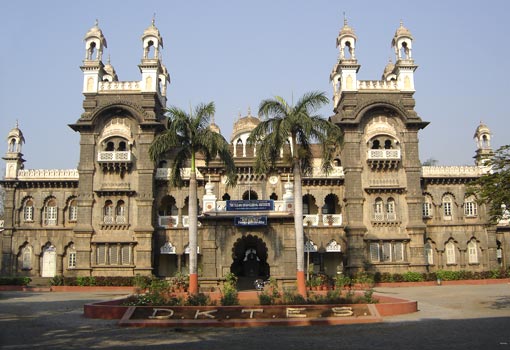
Overview
Ichalkaranji is a city and municipal council in the Kolhapur district of the Indian state of Maharashtra. Located in the southern part of the state, it lies on the banks of the Panchganga river and is widely known as a centre of the textile industry, particularly for cotton yarn, power looms, and fabric production. The city is sometimes referred to as the "Manchester of Maharashtra" because of its concentration of textile mills and weaving units.
Key facts
| Name | Ichalkaranji |
|---|---|
| Country | India |
| State | Maharashtra |
| District | Kolhapur |
| Region | Western Maharashtra |
| River | Panchganga |
| Languages | Marathi (primary), Hindi, English |
| Known for | Textiles, power looms, cotton yarn |
Geography
Ichalkaranji is situated in the Deccan plateau region of southern Maharashtra, close to the border with Karnataka. The Panchganga, a tributary of the Krishna river, flows near the town and has historically supported agriculture and water supply in the area. The surrounding region is largely agricultural, with sugarcane, jowar, and groundnut among the principal crops.
History
Before independence, Ichalkaranji was the seat of the Ichalkaranji princely state, a non-salute jagir under the suzerainty of the Maratha Confederacy and later the British Raj. The state was administered by the Ghorpade family, who were related to the rulers of Kolhapur. The town developed under their patronage and gradually emerged as a trading and weaving centre.
After the independence of India in 1947, the princely state was integrated into the Bombay State, and on the reorganisation of states in 1960, it became part of Maharashtra. The municipal council was established to administer the growing town, and Ichalkaranji subsequently expanded into one of the largest urban centres of Kolhapur district.
Economy
The economy of Ichalkaranji is dominated by the textile industry. The city is a major hub for power-loom weaving, cotton spinning, sizing, processing, and garment manufacturing. Cooperative spinning mills and a large number of small and medium textile units form the backbone of local employment. Allied industries include dyeing, bleaching, and machinery manufacturing for textile production. Agriculture and agro-processing also contribute to the regional economy, with sugar factories operating in the surrounding talukas.
Civic administration
Ichalkaranji is administered by a municipal council, which is responsible for civic services such as water supply, sanitation, roads, and local taxation. The town falls within the Hatkanangle Lok Sabha constituency for parliamentary representation and has its own assembly constituency for the Maharashtra Legislative Assembly.
Transport
The city is connected by road to Kolhapur, Sangli, and other towns in western Maharashtra. The nearest major railway junction is at Kolhapur, while Hatkanangle railway station on the Pune–Bengaluru line lies closer to the town. The nearest airport with regular commercial services is at Kolhapur.
Education and culture
Ichalkaranji has a network of schools and colleges, including engineering, arts, science, and commerce institutions affiliated to Shivaji University, Kolhapur. The town hosts cultural and literary activities in Marathi, and has produced notable figures in literature, industry, and public life. Traditional festivals such as Ganesh Chaturthi, Diwali, and Gudi Padwa are widely celebrated.
Significance
Ichalkaranji's significance lies primarily in its industrial role. As one of the leading textile clusters in India, it contributes substantially to the country's cotton fabric and yarn output and provides livelihood to a large population of weavers, factory workers, and traders both within the city and from neighbouring districts.
Related topics
- Kolhapur district
- Maharashtra
- Panchganga River
- Textile industry in India
- Ichalkaranji State
- Shivaji University
- Hatkanangle Lok Sabha constituency
References
- Wikidata entity: Q
Comments
0 comments
No comments yet.