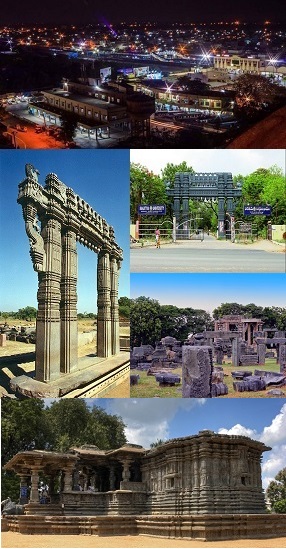
Overview
Warangal is a city in the state of Telangana, India, and serves as the headquarters of Warangal district. Historically known as Orugallu or Ekasila Nagaram (meaning "single stone city"), it was the capital of the Kakatiya dynasty between the 12th and 14th centuries. The city is widely regarded as the cultural and historical heart of Telangana, known for its medieval forts, temples, and lakes.
Key facts
| Name | Warangal |
|---|---|
| Country | India |
| State | Telangana |
| District | Warangal |
| Historical names | Orugallu, Ekasila Nagaram |
| Historical capital of | Kakatiya dynasty |
| Languages | Telugu, Urdu |
Background and geography
Warangal is located in the northern part of Telangana, on the Deccan Plateau. The city, along with the adjoining settlements of Hanamkonda and Kazipet, forms a tri-city urban agglomeration that has long functioned as a single civic and economic unit. The terrain around the city features rocky outcrops and several large irrigation tanks, including Bhadrakali Lake and Waddepally Lake, which were developed during and after the Kakatiya period.
History
Kakatiya period
Warangal rose to prominence under the Kakatiya rulers, who shifted their capital here from Hanamkonda. Notable monarchs associated with the city include Ganapati Deva, Rudrama Devi, and Prataparudra II. Under the Kakatiyas, Warangal became a major centre of Telugu culture, temple architecture, and trade.
Later medieval period
The Kakatiya kingdom fell to the Delhi Sultanate in the early 14th century after invasions led by forces of Alauddin Khalji and later Muhammad bin Tughlaq. The region subsequently came under the control of the Musunuri Nayakas, the Bahmani Sultanate, the Qutb Shahi dynasty of Golconda, the Mughal Empire, and finally the Asaf Jahi Nizams of Hyderabad.
Modern era
Following the integration of Hyderabad State into the Indian Union in 1948, Warangal became part of Andhra Pradesh in 1956. With the formation of Telangana as a separate state on 2 June 2014, Warangal was designated one of the principal cities of the new state.
Monuments and heritage
- Warangal Fort – a 13th-century Kakatiya fortification known for its concentric ramparts and the iconic stone gateways (Kakatiya Kala Thoranam), one of which is featured in the emblem of Telangana.
- Thousand Pillar Temple – a Kakatiya-era temple at Hanamkonda dedicated to Shiva, Vishnu, and Surya, built during the reign of Rudradeva.
- Ramappa Temple – located in the nearby Mulugu area, inscribed on the UNESCO World Heritage List in 2021.
- Bhadrakali Temple – an ancient temple situated between Warangal and Hanamkonda.
Economy
The economy of Warangal is based on agriculture, handloom and powerloom textiles, granite, and trade. The city is a long-established centre for cotton and carpet weaving, and the Warangal durries are well known. Educational and healthcare services also contribute significantly to the local economy.
Education
Warangal hosts several institutions of higher learning, including the National Institute of Technology, Warangal (NIT Warangal), one of the oldest NITs in India, and Kakatiya University, established in 1976. The Kakatiya Medical College is among the prominent medical institutions in the region.
Transport
Kazipet Junction and Warangal railway station, on the Delhi–Chennai main line, are major railway nodes. The city is connected by National Highway 163 to Hyderabad and by other state highways to surrounding districts. The nearest major airport is Rajiv Gandhi International Airport at Hyderabad.
Culture
Warangal has a strong Telugu cultural tradition, with classical music, dance, and temple festivals being important parts of public life. Bathukamma and Bonalu are widely celebrated. The city's craft heritage includes Cherial scroll painting, practised in the surrounding region, and traditional weaving.
Related topics
- Kakatiya dynasty
- Telangana
- Warangal Fort
- Thousand Pillar Temple
- Ramappa Temple
- National Institute of Technology, Warangal
- Kakatiya University
- Hanamkonda
References
- Wikidata entity: Q25563103
Comments
0 comments
No comments yet.