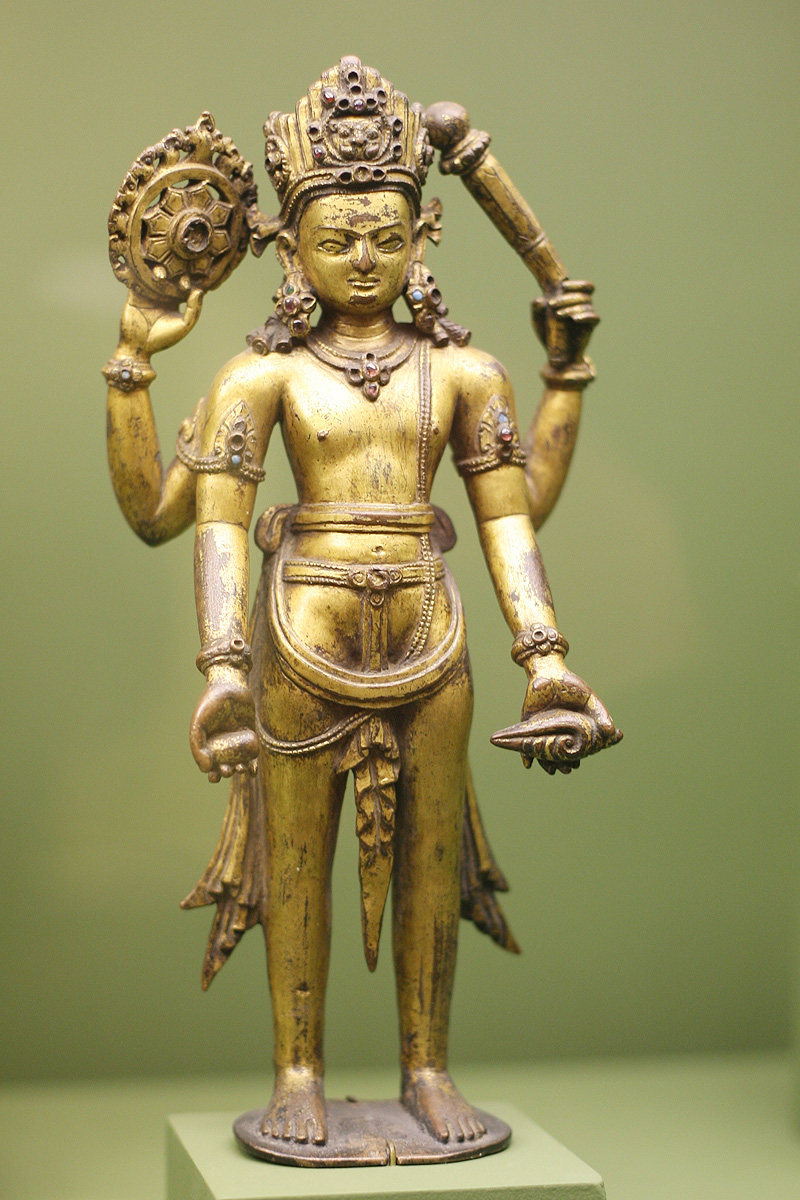
Overview
The Sudarshana Chakra (Sanskrit: सुदर्शनचक्र) is, in Hindu tradition, a divine spinning disc associated with the deity Vishnu. In iconography, it is generally depicted in the right rear hand of the four-armed Vishnu, who also bears the Panchajanya (conch), the Kaumodaki (mace), and the Padma (lotus).
In the Rigveda, the Sudarshana Chakra is described as a symbol of Vishnu, representing the wheel of time. In later traditions, the disc emerged as an ayudhapurusha, an anthropomorphic personification of the weapon, depicting a fierce aspect of Vishnu employed for the destruction of demons. In this personified form, the deity is known by names such as Chakraperumal, Chakratalvar, Chakradhara, and Chakrapani.
According to the Ramayana, Vishnu descends as his seventh avatar, Rama, at the plea of the devas, in order to slay Ravana. The Sudarshana Chakra is said to accompany him, along with Shesha and the Panchajanya, by taking the form of Shatrughna, the youngest brother of Rama and a prince of Ayodhya. Shatrughna is described as marrying Shrutakirti, who is regarded as an avatar of Lakshmi's chakra.
Comments
0 comments
No comments yet.