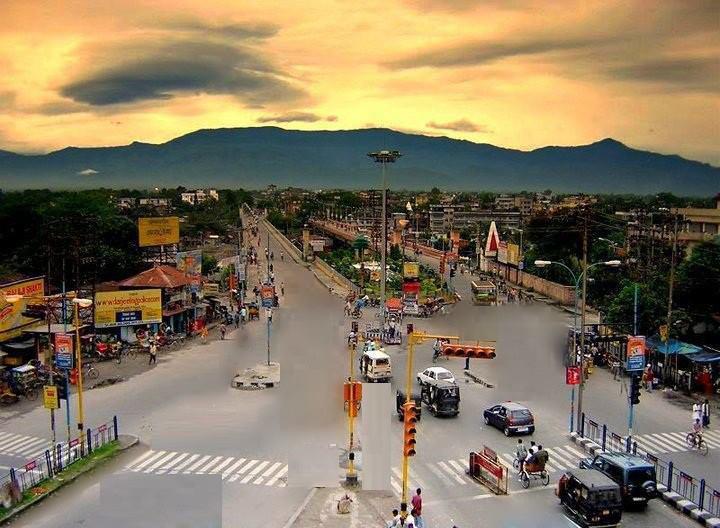
Overview
Siliguri is a city in the northern part of the Indian state of West Bengal. It is spread across the districts of Darjeeling and Jalpaiguri, and lies on the banks of the Mahananda River in the foothills of the Eastern Himalayas. Often described as the gateway to North-East India, Bhutan, Nepal and the Darjeeling Hills, Siliguri is one of the most important commercial, transport and educational hubs of eastern India.
| Country | India |
|---|---|
| State | West Bengal |
| Districts | Darjeeling, Jalpaiguri |
| Region | North Bengal |
| Civic body | Siliguri Municipal Corporation |
| River | Mahananda |
| Languages | Bengali, Nepali, Hindi, English |
| Nearest airport | Bagdogra Airport |
| Major railway station | New Jalpaiguri (NJP) |
Geography
Siliguri lies in the Terai belt at the base of the Himalayas. The city sits within the narrow strip of Indian territory known as the Siliguri Corridor or "Chicken's Neck", which connects the Indian mainland with the seven North-Eastern states. To its north rise the Darjeeling and Kalimpong hills; to the east lies the plains of Jalpaiguri and the Dooars; to the west, the international border with Nepal; and the border with Bangladesh lies a short distance to the south. Bhutan is to the north-east.
The Mahananda River flows through the city, with the Balason and Teesta rivers nearby. The climate is humid subtropical, with heavy monsoon rains influenced by the proximity of the Himalayas.
History
Siliguri grew as a small market settlement on the trade route between the plains of Bengal and the hill town of Darjeeling. Its development accelerated after the construction of the Darjeeling Himalayan Railway in the late 19th century, which used Siliguri as its plains terminus.
The Partition of India in 1947 dramatically changed the city's significance. With East Pakistan (later Bangladesh) cutting off the older rail and road routes through the Bengal plains, Siliguri became the principal land link between the rest of India and the North-Eastern region, giving the surrounding corridor enduring strategic importance. The shifting of railway operations and the establishment of New Jalpaiguri (NJP) station as a broad-gauge junction further consolidated the town's role as a transport node.
The Siliguri Municipal Corporation was constituted to administer the rapidly expanding urban area, replacing the earlier municipality.
Economy
Siliguri is the largest commercial centre of North Bengal and a major distribution hub for tea, timber and tourism — sometimes summarised locally as the "three Ts". The city houses one of the largest tea auction centres in the country, handling produce from the Darjeeling, Dooars and Terai gardens. Wholesale and retail trade, transport logistics, hospitality, education and healthcare are leading sectors. It also serves as a regional banking and financial hub for North Bengal, Sikkim, Bhutan and parts of Nepal.
Transport
Rail
New Jalpaiguri (NJP) is the main railway junction and one of the busiest stations in eastern India, connecting the North-East with the rest of the country. Siliguri Junction and Siliguri Town are older stations that continue to handle regional services. NJP is also the starting point of the heritage Darjeeling Himalayan Railway, a UNESCO World Heritage Site.
Road
Several National Highways converge on Siliguri, making it a critical junction for traffic to Sikkim, Bhutan, Nepal, Bangladesh and the North-Eastern states. The North Bengal State Transport Corporation operates from the city, alongside numerous private long-distance and Himalayan routes.
Air
Bagdogra Airport, located on the south-western outskirts, is the principal airport for the region. It handles domestic flights to major Indian cities and limited international services, and is the main air gateway for tourists travelling to Darjeeling, Sikkim and Bhutan.
Education and healthcare
Siliguri hosts the University of North Bengal, located on its outskirts, which is the principal state university for the region. Other institutions include the North Bengal Medical College and Hospital, engineering and management colleges affiliated to state universities, and a wide network of secondary schools serving students from across North Bengal, Sikkim and neighbouring countries. The city is also a regional referral centre for healthcare, with several large public and private hospitals.
Culture and demographics
Siliguri's population is multilingual and multi-ethnic, reflecting its position at a crossroads of cultures. Bengali, Nepali and Hindi are widely spoken, alongside Rajbanshi, Bhojpuri and various tribal languages of the Dooars and the hills. Major festivals include Durga Puja, Kali Puja, Dasain–Tihar, Chhath, Buddha Purnima, Eid and Christmas. The city's cuisine reflects Bengali, Nepali, Tibetan and North-Eastern influences, with momos, thukpa and street food enjoying widespread popularity.
Strategic significance
Because of its location within the Siliguri Corridor, the city has long been considered strategically vital. It is close to the trijunction of India, Nepal and Bhutan, and not far from the borders of Bangladesh and the Chinese-administered Tibet. Indian Army formations and paramilitary units, including the Sashastra Seema Bal, maintain a strong presence in and around the city, and the nearby Bagdogra Air Force Station is an important military airbase.
Sports
Football and cricket are the most popular sports. The Kanchenjunga Stadium, located in the heart of the city, is used for football matches, cricket and large public events, and has hosted matches in national football competitions.
Comments
0 comments
No comments yet.