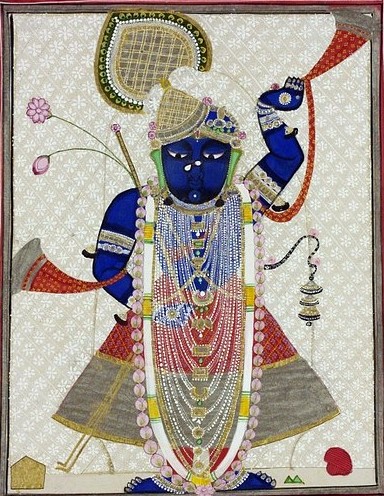
Overview
Shrinathji is a form of the Hindu deity Krishna, venerated as a manifestation of the divine in the form of a seven-year-old child. He is the central presiding deity of the Vaishnava sect known as Pushtimarg, also called the Vallabha Sampradaya, established by the saint Vallabhacharya. The deity is principally enshrined at the Shrinathji Temple in Nathdwara, a temple town located approximately 48 kilometres north-east of Udaipur in the Indian state of Rajasthan. The image and the tradition of worship surrounding Shrinathji occupy a significant place within the broader landscape of Krishna devotion (bhakti) in western India, particularly among devotees in Gujarat and Rajasthan.
Background
The worship of Shrinathji is rooted in the Pushtimarg tradition, whose name translates as "the way of grace." This devotional path was established by Vallabhacharya, who laid the theological and liturgical foundations for the sect. According to the tradition, the iconography of Shrinathji depicts Krishna as a child who lifted the Govardhan hill, an episode well-known in Vaishnava narrative literature in which Krishna is said to have shielded the residents of Vraja from torrential rains sent by Indra. In the iconographic form of Shrinathji, the deity's left hand is raised, evoking this act of lifting Govardhan.
In the early phases of the tradition, the child Krishna deity was referred to as Devadāman, a name meaning "the conqueror of Gods," interpreted as a reference to the overpowering of Indra during the lifting of the Govardhan hill. Vallabhacharya subsequently named the deity Gopala and designated his place of worship as Gopalpur. The name Shrinathji, by which the deity is most widely known today, was given later by Vitthal Nathji, the son of Vallabhacharya. Vitthal Nathji is also credited with institutionalising the formal worship of Shrinathji at Nathdwara, shaping the devotional practices that continue within the Pushtimarg tradition.
Career or topic context
The worship of Shrinathji is structured around an elaborate daily devotional schedule. The seva, or service, of the deity is performed in eight parts of the day, each corresponding to a phase of the deity's symbolic daily life as a child Krishna. These divisions of seva form the liturgical heart of Pushtimarg worship and are observed in the principal shrine at Nathdwara as well as in other temples and household shrines associated with the tradition. The pattern of eightfold seva reflects the sect's emphasis on a relationship of intimate, loving service between the devotee and the deity, regarded as a child to be cared for through the day.
The principal shrine of Shrinathji at Nathdwara has long been associated with the Vallabha Sampradaya. Owing to the centrality of the deity in the religious life of the city, Nathdwara itself is often referred to as 'Shrinathji'. The town is colloquially known as Bava's Nagri or Shreenathji Bava's Nagri, a term of affection used by devotees. The temple at Nathdwara serves as a major pilgrimage destination for followers of the Pushtimarg, drawing devotees especially from Gujarat and Rajasthan.
Among the communities most closely associated with the worship of Shrinathji are followers of Bhakti Yoga and Vaishnavas of Gujarat and Rajasthan. The Bhatia community, among others, has historically maintained strong devotional ties with the tradition. The Pushtimarg has cultivated a distinctive culture of devotional music, painting (notably the Pichhwai tradition of cloth paintings depicting Shrinathji and scenes from Krishna's life), cuisine offered to the deity, and ornamental dress, all of which contribute to the rich visual and ritual environment surrounding the deity at Nathdwara.
Significance
Shrinathji holds significance within Hinduism as a focal point of one of the most widely followed Krishna-centric devotional traditions in western India. As the principal deity of the Pushtimarg, Shrinathji embodies the sect's theological emphasis on grace (pushti) as the means through which the devotee approaches the divine. The depiction of Krishna as a seven-year-old child invites a devotional disposition characterised by tenderness, parental affection (vatsalya bhava), and intimate service.
The town of Nathdwara has, over time, developed a distinctive religious and cultural identity that is inseparable from the worship of Shrinathji. The deity's prominence has shaped the artistic, musical, culinary, and craft traditions of the region, and the Pichhwai paintings associated with the shrine are recognised as a significant strand of Indian devotional art. The eightfold daily seva continues to structure the rhythm of religious life for many devotees, both at the temple and within domestic shrines maintained by Pushtimarg households.
The institutional history of the tradition, with Vallabhacharya as its founder and Vitthal Nathji as the figure who organised the worship at Nathdwara and gave the deity the name Shrinathji, also illustrates the sustained transmission of a sectarian Vaishnava lineage across generations. The continued vitality of the tradition is reflected in the wide reach of the sect among its primary devotee communities and in the ongoing pilgrimage traffic to Nathdwara.
References
- "Shrinathji", English Wikipedia, available at https://en.wikipedia.org/wiki/Shrinathji (source of the notes used in preparing this draft).
Comments
0 comments
No comments yet.