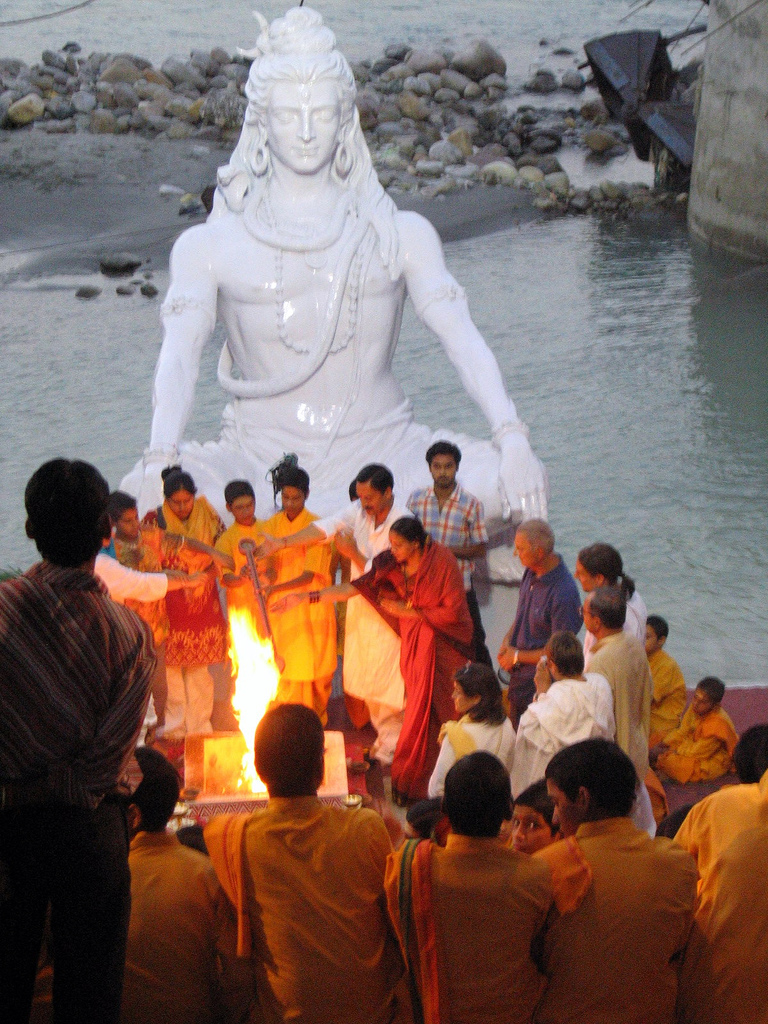
Overview
Shaivism (Sanskrit: शैवसंप्रदायः, Śaivasampradāyaḥ) is an umbrella term for a group of Hindu religious traditions that regard Shiva as the supreme being. Adherents are known as Shaivas or Shaivites, and according to the source notes they number approximately 385 million people across South Asia, predominantly in India, Sri Lanka, and Nepal. The tradition is one of the principal streams of Hinduism, alongside Vaishnavism, Shaktism, and the Smarta tradition, and is distinguished by a rich diversity of theological positions, ritual practices, and monastic and householder communities.
This article summarises the development, branches, and significance of Shaivism as described in the source material. Because Shaivism is not a single church or organised denomination but a family of related traditions, much of the discussion concerns historical formation, textual lineages, and regional expressions rather than a centralised doctrine.
Background
Shaivism is described in the source notes as having developed as an amalgam of pre-Aryan religions and traditions, the Vedic deity Rudra, and post-Vedic developments. Over time it accommodated local traditions and integrated practices such as Yoga, puja (ritual worship), and bhakti (devotion). The earliest traceable root of Shaivism is identified with the worship of the Vedic Rudra, though the figure of Shiva as encountered in later devotional and tantric literature draws on a much wider pool of sources.
The earliest evidence for distinctly sectarian Rudra-Shiva worship is associated with the Pāśupata movement, which is dated in the source notes to the early Common Era. The Pāśupatas emerged during the broader process sometimes called the Hindu synthesis, in which many local traditions were aligned with the Vedic–Brahmanical fold. From its early bases the Pāśupata movement is said to have expanded rapidly throughout North India, giving rise to different forms of Shaivism and to the subsequent emergence of various tantric traditions.
By the 1st millennium CE, both devotional and monistic forms of Shaivism had become widely popular, and the tradition is described as having become the dominant religious orientation of several Hindu kingdoms. Shaivism also spread into Southeast Asia in this period. The source notes record the construction of thousands of Shaiva temples in present-day Indonesia, as well as in Cambodia and Vietnam, where Shaivism co-evolved with Buddhism. Editors are encouraged to verify the regional details and chronologies independently against scholarly sources before publication.
Career or topic context
Within Shaivism, the source notes draw a basic historical distinction between Puranic Shaivism and non-Puranic (Agamic or Tantric) Shaivism. Puranic Shaivism is associated with Shiva-worship as it is practised in the Smarta tradition and in widely shared forms of devotional Hindu life. Non-Puranic Shaivism is rooted in the Agamic and Tantric textual corpus and is itself further divided.
According to the source, the non-Puranic stream is divided into the atimārga, intended solely for sanyassins or ascetic renunciates, and the mantramārga, which is open to both renunciates and householders. The atimārga preserves an older ascetic orientation associated with the Pāśupata and related lineages, while the mantramārga has been historically more accessible to lay practitioners and has produced an extensive ritual and theological literature.
Within the mantramārga, two broad theological orientations are highlighted in the source. The first is Shaiva Siddhanta, characterised as a devotional dualistic theism in which Shiva, the soul, and the world are distinguished, and liberation is conceived through grace and ritual practice. The second is the Tantric Kapalika current, which is described as having given rise to a number of yoga-oriented monistic systems. Among these are the Trika tradition and the Kashmiri Shaiva schools, which articulate non-dualistic interpretations of Shiva as the ultimate consciousness.
The source notes also observe that Tantric Shaivism is closely related to Shaktism, the worship of the Goddess (Shakti). Some Shaivas are reported to worship in both Shiva and Shakti temples, reflecting the long-standing theological understanding that Shiva and Shakti are inseparable aspects of the same reality. Editors should expand on specific sub-traditions—such as Lingayat or Vira Shaiva, Nath, Aghori, and various South Indian temple lineages—only with reference to suitable sources, as these are not detailed in the present source notes.
Significance
Shaivism's significance, as outlined in the source notes, lies in several overlapping areas. First, it is one of the most widely followed traditions within Hinduism, with adherents in India, Sri Lanka, Nepal, and the wider South Asian diaspora. Second, it embodies a long historical process by which Vedic, post-Vedic, and local religious traditions were brought together, demonstrating the syncretic character of Hindu religious history.
Third, Shaivism has had a substantial cultural footprint beyond South Asia. The construction of Shaiva temples across Southeast Asia, including in Indonesia, Cambodia, and Vietnam, contributed to the architectural, sculptural, and ritual heritage of those regions. The co-evolution of Shaivism with Buddhism in Southeast Asia is noted as a feature of this transmission, though the specific dynamics in each region are not detailed in the source notes.
Fourth, the tradition has produced a wide spectrum of philosophical positions, ranging from the dualistic theism of Shaiva Siddhanta to the non-dual systems associated with Trika and Kashmiri Shaivism. This range has made Shaivism a significant contributor to Indian philosophical discourse, alongside Vedanta and other schools. Finally, the close relationship of Tantric Shaivism with Shaktism is significant for understanding the broader structure of Hindu ritual and theology, especially in regions where Shiva and the Goddess are jointly central.
Editorial review notes
This draft has been prepared from a limited set of source notes derived from the English Wikipedia article on Shaivism. Reviewers and editors are advised to consider the following points before any publication:
- Verification of figures: The figure of approximately 385 million Shaivas comes from the source notes and should be verified against current demographic studies and Census data, with appropriate citation and date qualification.
- Chronological claims: Statements about the early Common Era origins of the Pāśupatas, the rapid expansion of Shaivism, and the timing of its spread to Southeast Asia should be checked against academic histories of Indian religion.
- Sub-tradition coverage: Major Shaiva sub-traditions in South India (such as Shaiva Siddhanta as practised in Tamil Nadu), the Lingayat and Vira Shaiva traditions of Karnataka, the Nath sampradaya, and Himalayan and Nepali forms of Shaivism are not detailed in the source notes and should be supplemented from authoritative sources before publication.
- Neutral framing: Beliefs and practices should be presented as part of textual traditions and lived communities, without endorsing or disputing their truth claims.
- Southeast Asian context: Claims about temple construction and co-evolution with Buddhism in Indonesia, Cambodia, and Vietnam should be supported with regional scholarship.
- Sensitive practices: Tantric and ascetic practices should be described with care, citing scholarly works rather than sensationalist sources.
- Style: Sanskrit terms have been transliterated using standard romanisation; editors may wish to apply IAST diacritics consistently throughout.
References
- Source: "Shaivism", English Wikipedia. Available at: https://en.wikipedia.org/wiki/Shaivism
- Source notes provided to the drafter, summarising key points from the above article.
- Editors are encouraged to consult standard academic references on Hinduism, Shaivism, and South and Southeast Asian religious history before publication.