Overview
The Mahābhārata (Sanskrit: महाभारतम्, Mahābhāratam, 'Great Bharata') is one of the two major Sanskrit epics of ancient India, the other being the Rāmāyaṇa. Both are smriti texts and together are known as the Itihāsas. Within the Indian tradition, the Mahābhārata is sometimes referred to as the fifth Veda.
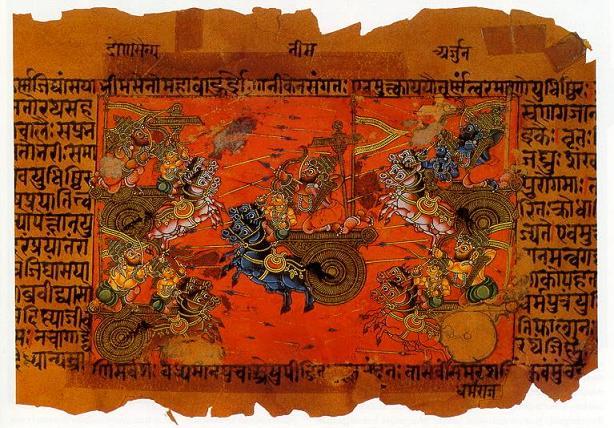
The epic narrates the events before, during, and after the Kurukshetra War, a war of succession between two groups of princely cousins, the Kauravas and the Pāṇḍavas. Alongside its central narrative, it contains extensive philosophical and devotional material, including a discussion of the four puruṣārtha or "goals of life". Among its principal embedded works and stories are the Bhagavad Gītā, the tales of Damayantī, Shakuntalā, Purūravā and Urvashī, Sāvitrī and Satyavān, Kacha and Devayānī, Ṛṣyaśṛṅga, and an abbreviated version of the Rāmāyaṇa.
Traditionally, authorship of the Mahābhārata is attributed to Vyāsa. Scholars have made many attempts to trace its historical growth and compositional layers. The bulk of the text was probably compiled between the 3rd century BCE and the 3rd century CE, with the oldest preserved portions not much older than around 400 BCE, and it likely reached its final form by the early Gupta period (c. 4th century CE).
The title has been rendered variously as "Great Bharat (India)", "the story of the great descendants of Bharata", or "The Great Indian Tale". It is among the longest epic poems known: its longest version consists of over 1,00,000 shlokas (verses), or more than 2,00,000 individual lines, along with long prose passages. At roughly 1.8 million words, the Mahābhārata is about ten times the combined length of the Iliad and the
Comments
0 comments
No comments yet.