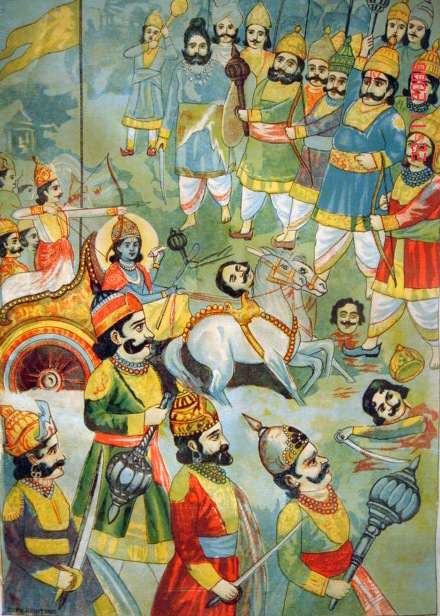
Overview
Kaurava is a Sanskrit term meaning "descendant of Kuru", referring to the lineage descending from Kuru, a legendary king of ancient India. As Kuru is presented as the ancestor of many central figures of the epic Mahabharata, the term in its broadest sense can apply to a wide range of characters in the narrative tradition.
In common usage, however, the term Kaurava is applied specifically to the hundred sons of King Dhritarashtra and his wife Gandhari. This narrower sense is the one most often encountered in retellings of the Mahabharata, where the Kauravas are distinguished from their cousins, the Pandavas, the sons of Pandu.
Among the hundred Kaurava brothers, the most prominent in the epic tradition are Duryodhana, the eldest, along with Dushasana, Vikarna and Chitrasena. Duryodhana is portrayed as the principal figure of the group and his rivalry with the Pandavas forms one of the central threads of the narrative. Vikarna is sometimes noted within the tradition for occasionally taking positions different from those of his elder brothers.
In addition to the hundred sons, Dhritarashtra and Gandhari are described as having a daughter named Dussala. The Kauravas also had a half-brother, Yuyutsu, born to Dhritarashtra by another woman. Yuyutsu is depicted in the tradition as eventually siding with the Pandavas rather than with his half-brothers, and is thus distinguished from the hundred Kaurava brothers in the course of the epic.
The Kauravas, as a collective, occupy a major place in the storyline of the Mahabharata, particularly in connection with the dispute over the Kuru kingdom that culminates in the Kurukshetra war. Their lineage from Kuru links them to the wider Kuru dynasty, within which both they and the Pandavas are situated as cousins descended from a common ancestor.
Comments
0 comments
No comments yet.