Overview
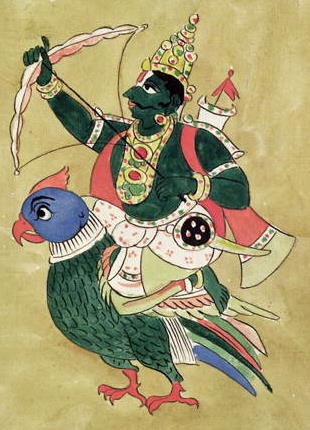
Kamadeva (Sanskrit: कामदेव, IAST: Kāmadeva), also known as Kama, Manmatha and Madana, is the Hindu god of love, attraction, pleasure and beauty. He is the personification of kāma, one of the four traditional aims of human life in Hindu thought. In iconography he is depicted as a handsome young man adorned with ornaments and flowers, wielding a bow of sugarcane and shooting arrows tipped with blossoms. He is often portrayed alongside his consort and female counterpart, Rati.
The origins of Kamadeva are traced to verses in the Rig Veda and the Atharva Veda. The Atharva Veda describes him as a powerful deity, the wielder of the creative power of the universe, stating that he was "born at first, him neither the gods nor the fathers ever equaled". These early references associate him with the generative impulse that pervades creation, before his characterisation was developed further in later texts.
In the Puranas, Kamadeva is generally described as a manasaputra, a mind-born son of the creator god Brahma. His most widely known narrative recounts his incineration by the third eye of the god Shiva, after he attempted to rouse Shiva from meditation in order to draw him towards Parvati. According to the same tradition, Kamadeva is later reborn on earth as Pradyumna, the eldest son of Krishna and his chief consort Rukmini.
Kamadeva occupies a notable place in Sanskrit literature, classical poetry and the iconographic traditions of Hinduism, where his bow, floral arrows and association with springtime have provided enduring motifs for poets and artists.
References
Adapted from the English Wikipedia article on Kamadeva.
Comments
0 comments
No comments yet.