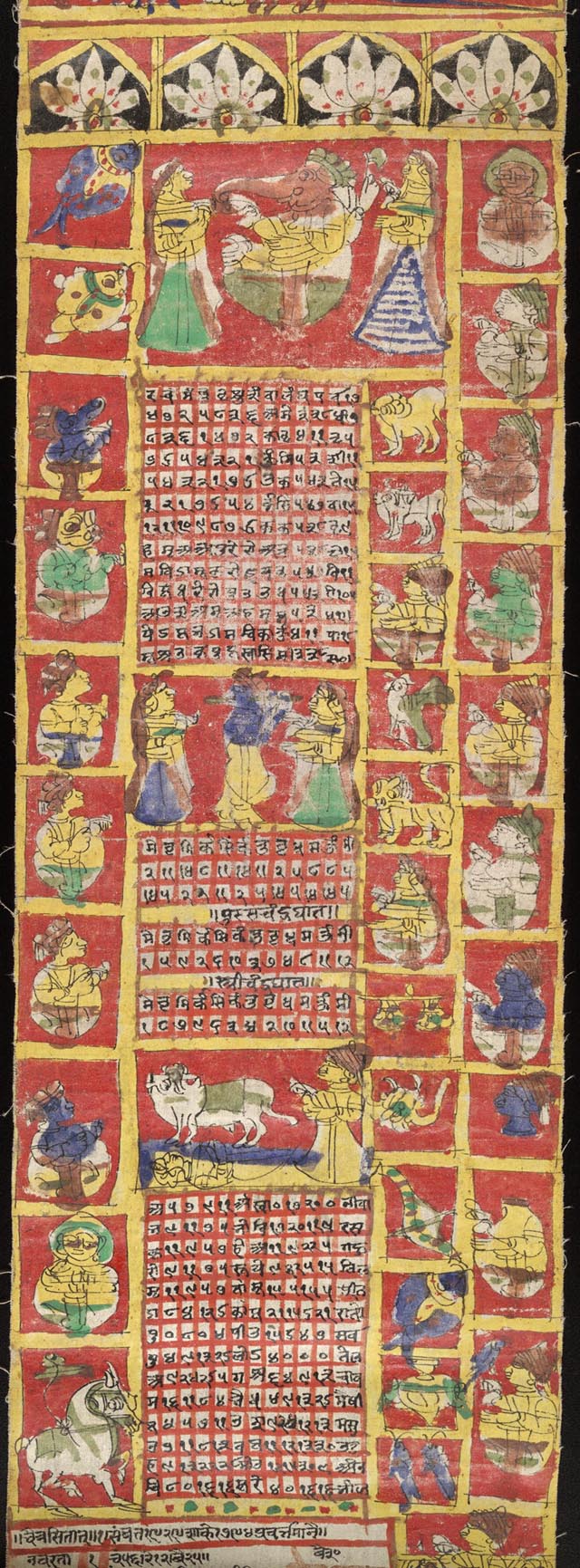
Overview
The Hindu calendar, commonly known as the Panchanga (Sanskrit: पञ्चाङ्ग), refers to a family of lunisolar calendars that have traditionally been used across the Indian subcontinent and parts of Southeast Asia. Rather than being a single unified system, the term encompasses several regional reckonings that share a common underlying framework but differ in their starting points, the relative emphasis placed on solar or lunar cycles, the names assigned to months, and the date observed as the New Year. The calendar serves both civil and religious purposes, governing the timing of festivals, agricultural rituals, and personal ceremonies among Hindu communities.
In eastern India, the calendar or its almanac form is also referred to as the Panjika, while in much of the rest of the country the term Panchangam (पञ्चाङ्गम्) is widely used. The word literally denotes the "five limbs" of traditional timekeeping, reflecting the calendar's composite structure derived from astronomical observation.
Background
According to the source material, the Hindu calendars have been in use in the Indian subcontinent since Vedic times and continue to be referenced by Hindu communities for religious and social observances. The conceptual design of the ancient Hindu calendar shares features with the Babylonian, Chinese, and Hebrew calendars, all of which combine solar and lunar elements. This contrasts with the Gregorian calendar, which is purely solar and adjusts the mismatch between lunar and solar years by altering the number of days within months.
The Hindu calendar approaches this same astronomical challenge differently. Twelve lunar cycles total approximately 354 days, while a solar year is approximately 365 days. Rather than redistributing days across the months, the Hindu system preserves the integrity of each lunar month and instead inserts an extra full month — known traditionally as an intercalary or adhika month — once every 32 to 33 months. This intercalation ensures that festivals tied to seasonal phenomena, as well as crop-related rituals, continue to occur during the appropriate part of the agricultural year.
Despite shared foundations, the various regional calendars diverge meaningfully. Some emphasise the lunar cycle in determining months and festival dates, while others give greater weight to the solar cycle, particularly for marking the New Year and the passage of seasons. The sidereal year forms the basis for the solar reckoning in most variants, with periodic adjustments made to align lunar months.
Career or topic context
Among the regional calendars associated with Hindu timekeeping, the source identifies several that have received particular scholarly attention:
- Shalivahana Shaka: Associated with King Shalivahana, this calendar is prevalent in the Deccan region of southern India. It also serves as the basis for the Indian national calendar. The Shalivahana Shaka emphasises the lunar cycle and observes its New Year in spring.
- Vikram Samvat (Bikrami): Used in Nepal as well as in northern and central regions of India, this calendar similarly emphasises the lunar cycle and begins its year in spring.
- Tamil calendar: In use in Tamil Nadu, this calendar emphasises the solar cycle. While it uses month names that parallel those found in the broader Hindu calendar tradition, its structural emphasis differs. Its origins are traced to the second half of the first millennium CE.
- Malayalam calendar: Used in Kerala, this calendar likewise gives primacy to the solar cycle and shares an origin period with the Tamil calendar in the latter half of the first millennium CE.
These regional traditions illustrate how a shared astronomical heritage has been adapted to local cultural, agricultural, and religious requirements. The choice of New Year, the names assigned to months, and the festivals observed at particular junctures of the year reflect this regional diversity.
Significance
The Hindu calendar continues to hold significance in several spheres of contemporary life on the subcontinent. In religious practice, it determines the timing of festivals, fasting days, and rites of passage. The Panchanga itself, as a published almanac, lists auspicious and inauspicious periods, planetary positions, and other information used by households and priests in scheduling ceremonies. The Panjika fulfils a similar role in the eastern part of the subcontinent.
From a civil standpoint, the Shalivahana Shaka forms the basis of the Indian national calendar, giving the Hindu calendrical tradition a formal place alongside the Gregorian system in Indian public life. In agricultural communities, the calendar's intercalary mechanism ensures that seasonal festivals continue to align with the agricultural cycle, which has been a central concern in its design.
From a comparative perspective, the Hindu calendar is one of several ancient lunisolar systems — alongside the Babylonian, Chinese, and Hebrew calendars — and offers a distinctive approach to reconciling solar and lunar reckonings. Its preservation of the lunar month as an integral unit, combined with the periodic insertion of an extra month, distinguishes it from the day-adjustment method used by the Gregorian system.
References
- "Hindu calendar", English Wikipedia. Source URL: https://en.wikipedia.org/wiki/Hindu_calendar
Comments
0 comments
No comments yet.