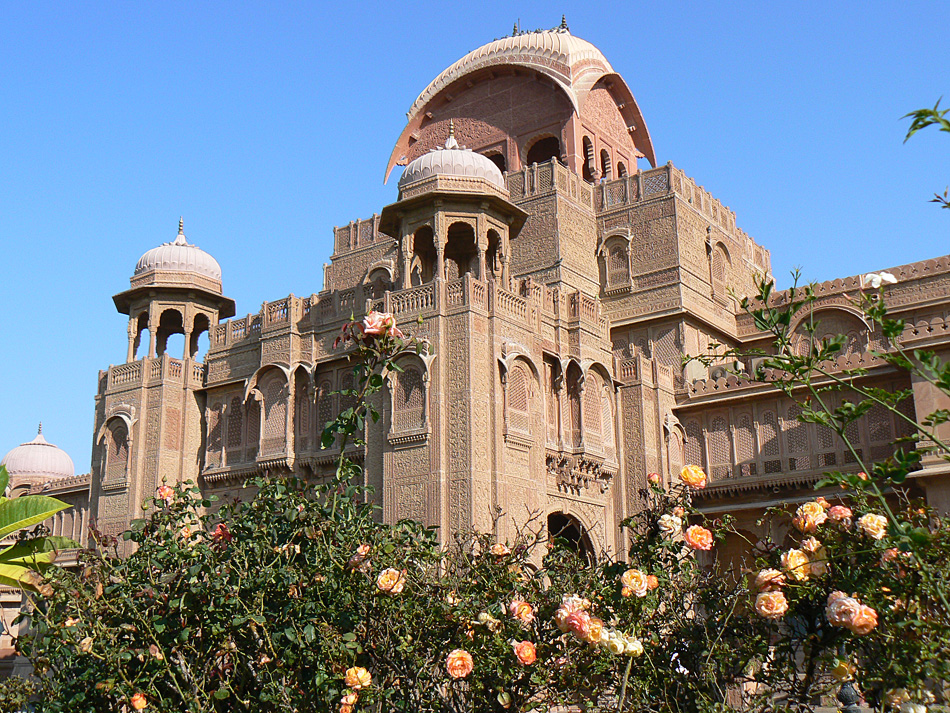
Bikaner is a city in the northern part of the state of Rajasthan in India. It serves as the administrative headquarters of Bikaner district and Bikaner division. Situated in the Thar Desert, the city is known for its medieval fortifications, its role as the capital of the former princely state of Bikaner, and its distinctive culinary and craft traditions.
| Country | India |
|---|---|
| State | Rajasthan |
| District | Bikaner |
| Division | Bikaner |
| Founded | 1488 |
| Founder | Rao Bika |
| Region | Thar Desert (Marwar/Jangladesh historically) |
| Languages | Rajasthani (Bagri, Marwari), Hindi |
Geography
Bikaner lies on the elevated plains of the Thar Desert in northwestern Rajasthan. The terrain is largely arid, characterised by sand dunes, scrub vegetation, and limited surface water. The climate is hot and semi-arid, with very high summer temperatures, cold winter nights, and low annual rainfall concentrated in the southwest monsoon months.
History
The city was founded in 1488 by Rao Bika, a son of Rao Jodha of Marwar (the founder of Jodhpur). Bika established his capital in the region then known as Jangladesh, drawing on alliances with local Jat clans and other communities. The state of Bikaner subsequently became one of the major Rathore principalities of Rajputana.
Under Raja Rai Singh (reigned 1571–1611), a senior general of the Mughal emperors Akbar and Jahangir, Bikaner expanded politically and culturally. Rai Singh commissioned Junagarh Fort, construction of which began in 1589. Later rulers such as Karan Singh, Anup Singh, Gaj Singh and Surat Singh further added palaces, temples and fortifications.
In 1818, the state of Bikaner entered into a subsidiary alliance with the British East India Company. Maharaja Ganga Singh (reigned 1887–1943) is regarded as the most prominent modern ruler of the state; he established the Ganga Canal, modernised civic administration, represented India at the Imperial War Cabinet during the First World War, and was a signatory of the Treaty of Versailles in 1919. After Indian independence in 1947, the princely state acceded to the Indian Union and was integrated into the state of Rajasthan in 1949–1950.
Landmarks
- Junagarh Fort – a fortified complex begun in 1589 under Rai Singh, with later additions including Anup Mahal, Karan Mahal, Phool Mahal and Chandra Mahal.
- Lalgarh Palace – built in the early twentieth century during the reign of Ganga Singh, designed in an Indo-Saracenic style by Sir Samuel Swinton Jacob; it houses the Sadul Singh Museum.
- Karni Mata Temple – located at Deshnoke, around 30 km south of the city, dedicated to the goddess Karni Mata and known for the rats considered sacred there.
- Laxmi Niwas Palace – part of the Lalgarh complex, now operating as a heritage hotel.
- Rampuria Havelis – a cluster of merchant mansions in the old city, noted for their red sandstone facades and detailed jharokha work.
- Bhandasar Jain Temple – a fifteenth–sixteenth century temple dedicated to the fifth Tirthankara, Sumatinatha.
Economy
Bikaner's economy combines agriculture, animal husbandry, handicrafts, tourism and small-scale industry. The surrounding region produces guar, bajra, moth and groundnut, while sheep and camel rearing remain significant. The city is widely known for Bikaneri bhujia, a savoury snack that holds a Geographical Indication (GI) tag, and for sweets such as rasgulla and ghewar produced by local sweet-makers. Other notable products include woollen textiles, leatherwork and usta art on camel hide.
Institutions
- National Research Centre on Camel (ICAR-NRCC), located at Jorbeer, focused on research on camel breeding, health and dairy.
- Central Sheep and Wool Research Institute branch at Bikaner.
- Maharaja
Comments
0 comments
No comments yet.