Overview
Bappi Lahiri (born Alokesh Lahiri; 27 November 1952 – 15 February 2022) was an Indian singer, composer, and music director who became one of the most recognisable figures of Hindi film music in the 1980s. He is widely credited with popularising disco-influenced soundtracks in Bollywood, earning him the moniker "Disco King" of Indian cinema. His distinctive style, signature gold ornaments, and prolific output across Hindi, Bengali, Tamil, Telugu, and Kannada cinema made him a culturally significant figure in Indian popular music.
Key facts
| Birth name | Alokesh Lahiri |
|---|---|
| Born | 27 November 1952, Jalpaiguri, West Bengal, India |
| Died | 15 February 2022, Mumbai, Maharashtra |
| Occupation | Composer, singer, music director, playback singer |
| Years active | 1972–2022 |
| Languages | Hindi, Bengali, Tamil, Telugu, Kannada, Gujarati |
| Spouse | Chitrani Lahiri |
| Children | Bappa Lahiri, Rema Lahiri |
| Notable genre | Bollywood disco, film music |
Background and family
Bappi Lahiri was born into a Bengali Brahmin family of musicians in Jalpaiguri, West Bengal. His father, Aparesh Lahiri, was a noted Bengali singer, and his mother, Bansari Lahiri, was a singer and musician trained in classical music and Shyama Sangeet. He was a relative of the legendary playback singer Kishore Kumar, who was a maternal uncle. Bappi began learning the tabla at age three and was trained in music from an early age by his parents.
Career
Early years
Lahiri began his film music career in Bengali cinema with the film Daadu (1972). He moved to Mumbai in the early 1970s to work in Hindi cinema. His first Hindi film as composer was Nanha Shikari (1973), but recognition came with Zakhmee (1975), for which he composed the music and also sang playback.
Rise to fame and the disco era
Lahiri rose to prominence with Tahir Husain's Chalte Chalte (1976), and consolidated his reputation with Aap Ki Khatir (1977), which featured the popular track "Bambai Se Aaya Mera Dost". The late 1970s and 1980s established him as the leading exponent of disco music in Hindi cinema. His landmark soundtracks include:
- Surakksha (1979) – introduced the "Mr. Bond / Gunmaster G-9" theme.
- Disco Dancer (1982) – directed by B. Subhash and starring Mithun Chakraborty; the album, including "I Am a Disco Dancer" and "Jimmy Jimmy Jimmy Aaja", became internationally popular, particularly in the Soviet Union and China.
- Namak Halaal (1982) – featured "Pag Ghungroo Bandh" and "Jawani Jaaneman".
- Sharaabi (1984) – earned him the Filmfare Award for Best Music Director.
- Dance Dance (1987), Commando (1988), Guru (1989) – continued his association with Mithun Chakraborty.
Later career
Lahiri's output declined in the 1990s with the changing sound of Hindi film music, but he remained active as a composer and singer. He returned to wider attention with the song "Bombai Nagariya" in Taxi No. 9211 (2006) and performed for films such as Chalte Chalte (2003), The Dirty Picture (2011, where his earlier songs were reworked), and Gunday (2014). He also worked in regional cinema throughout his career, composing extensively for Bengali films.
International recognition
"Jimmy Jimmy Jimmy Aaja" from Disco Dancer achieved cult status in the USSR, Eastern Europe, and parts of East Asia. In 2002, the American hip-hop artist Truth Hurts sampled Lahiri's composition "Thoda Resham Lagta Hai" (originally sung by Lata Mangeshkar for the 1981 film Jyoti) in the song "Addictive", produced by DJ Quik. The subsequent legal case underlined issues of sampling and credit in international music.
Politics
Lahiri joined the Bharatiya Janata Party (BJP) in January 2014 and contested the 2014 Lok Sabha elections from the Srerampur constituency in West Bengal, finishing fourth.
Personal life and signature style
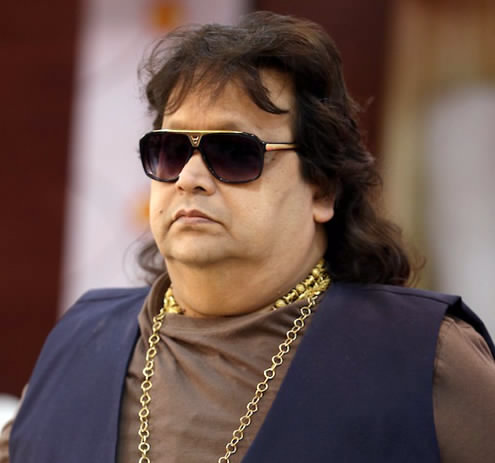
Lahiri was married to Chitrani Lahiri. The couple had two children: their son Bappa Lahiri, also a composer, and daughter Rema Lahiri. Bappi Lahiri became known publicly for his fondness for gold jewellery and dark sunglasses, a style he often attributed to inspiration from Elvis Presley and which became part of his public persona.
Death
Bappi Lahiri died on 15 February 2022 at CritiCare Hospital in Juhu, Mumbai, at the age of 69. The reported cause of death was obstructive sleep apnoea and recurrent chest infection.
Awards and honours
- Filmfare Award for Best Music Director – Sharaabi (1985).
- Numerous Bengali film music awards across his career.
- Lifetime achievement honours from various Indian and international music bodies.
Significance
Bappi Lahiri's work redefined the sound of mainstream Hindi cinema in the 1980s by integrating synthesisers, drum machines, and disco rhythms into film songs at a time when orchestral arrangements dominated. His compositions provided the musical identity for the on-screen image of Mithun Chakraborty and shaped the dance-film genre in India. His cross-border popularity, particularly in the Soviet bloc, made him one of the earliest Indian film composers to achieve sustained international audience recognition.
Related topics
- Disco Dancer
- Mithun Chakraborty
- Kishore Kumar
- Bollywood music
- Filmfare Award for Best Music Director
- Bengali cinema
- Sharaabi
- Namak Halaal
References
- Filmfare Awards official records.
- Archives of The Times of India, The Hindu, and Anandabazar Patrika on Indian film music history.
- Election Commission of India records, 2014 Lok Sabha general election.
Comments
0 comments
No comments yet.