Overview
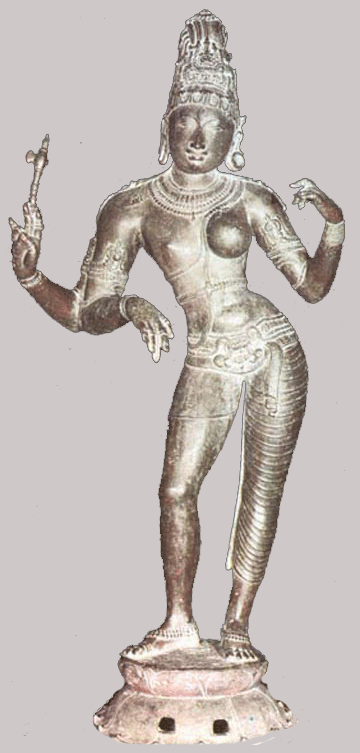
Ardhanarishvara (Sanskrit: अर्धनारीश्वर, Ardhanārīśvara, literally "the half-female Lord") is a composite form of the Hindu deity Shiva together with his consort Parvati. The icon is depicted as half-male and half-female, equally divided down the central vertical axis of the body. In most representations, the right half is the male Shiva, retaining his traditional attributes, while the left half is the female form associated with Parvati. The image is regarded within Hindu tradition as a visual synthesis of the masculine and feminine principles of the cosmos, and is found widely across Indian temple iconography.
Background
The Ardhanarishvara form draws upon long-standing currents in Hindu thought concerning the complementary nature of masculine and feminine energies. In philosophical terms, this duality is often discussed through the categories of Purusha (the masculine, often understood as consciousness or the cosmic person) and Prakriti (the feminine, often understood as nature or generative matter). Ardhanarishvara visualises the union of these two principles in a single body, presenting them as inseparable rather than opposed.
Within Shaiva traditions, the form also conveys the doctrine that Shakti, understood as the female principle of the divine, is inseparable from Shiva, the male principle, and, in some interpretations, identical with him. The composite image is accordingly described in textual sources as a symbol of the union from which creation issues, sometimes referred to as the root and womb of the manifested universe. Another interpretive strand holds that Ardhanarishvara expresses the all-pervasive nature of Shiva, in whom all polarities are encompassed.
The earliest known images of Ardhanarishvara have been dated to the Kushan period, with examples beginning from around the first century CE. The iconography developed further during subsequent centuries and is generally regarded as having reached a mature form during the Gupta era, after which it became a standard subject in stone sculpture, bronze casting, and temple ornamentation across the subcontinent.
Career or topic context
As a religious and iconographic subject, Ardhanarishvara appears in several layers of Hindu literature and art. The Puranas — a body of narrative and devotional texts — recount episodes and explanations associated with the form, while iconographic treatises (the shilpa and agama literature) describe how the image should be conceived and rendered by sculptors. These texts typically prescribe the proportions, attributes, ornaments, and posture appropriate to each half of the composite figure.
In conventional depictions, the male right half displays attributes associated with Shiva, which may include matted hair (jata) gathered on the head, a crescent moon, a serpent, an earring of a particular type, a broader chest, and weapons or emblems such as the trident in the corresponding hand. The female left half typically displays features associated with Parvati, including a developed breast, a differently styled coiffure, distinct earrings and ornaments, and garments and bodily contours rendered in a manner conventional for goddess imagery. The vertical line dividing the two halves is often emphasised through the careful contrast of dress, jewellery, and bodily form rather than by a literal seam.
Ardhanarishvara remains a popular iconographic form found in most Shiva temples throughout India, where it appears as a panel, niche figure, or processional bronze among the broader programme of Shaiva imagery. Despite this widespread presence, only a small number of temples are specifically dedicated to Ardhanarishvara as the principal deity. The form is also reflected in classical dance, devotional poetry, and visual arts beyond temple sculpture, where the theme of inseparable masculine and feminine continues to be interpreted.
Significance
Within Hindu traditions, Ardhanarishvara carries layered theological and symbolic meanings. As a doctrinal image, it expresses the conviction that the divine encompasses both masculine and feminine aspects, and that creation arises from their union rather than from either principle in isolation. This understanding is articulated in Shaiva and Shakta theologies, each of which may emphasise different aspects of the same composite form.
Ardhanarishvara is also significant as an artistic subject. Its iconography poses a distinctive challenge to sculptors and painters, who must render two ideal forms — masculine and feminine — within a single, balanced figure. The handling of this challenge across different periods and regional schools provides art historians with material for tracing stylistic developments, including changes in proportion, ornament, and treatment of drapery. Notable examples in stone and bronze are preserved in temples and museum collections in various parts of India.
References
- "Ardhanarishvara." English Wikipedia. https://en.wikipedia.org/wiki/Ardhanarishvara (source for the present draft).
Comments
0 comments
No comments yet.